Why Is My Resin Floor Peeling? (And How to Fix It Permanently)
There is nothing more frustrating than investing in an epoxy or resin floor, only to watch it bubble, blister, or peel off in sheets months later.
Whether it is hot tires pulling up paint in a garage or large patches delaminating in a commercial workshop, resin failure is a common problem. However, the fault rarely lies with the resin itself. In over 90% of cases, resin floors fail due to errors made during the subfloor preparation and priming phase.
In this guide, we break down the root causes behind peeling resin floors and explain the exact technical steps needed to strip, repair, and install a permanent finish.
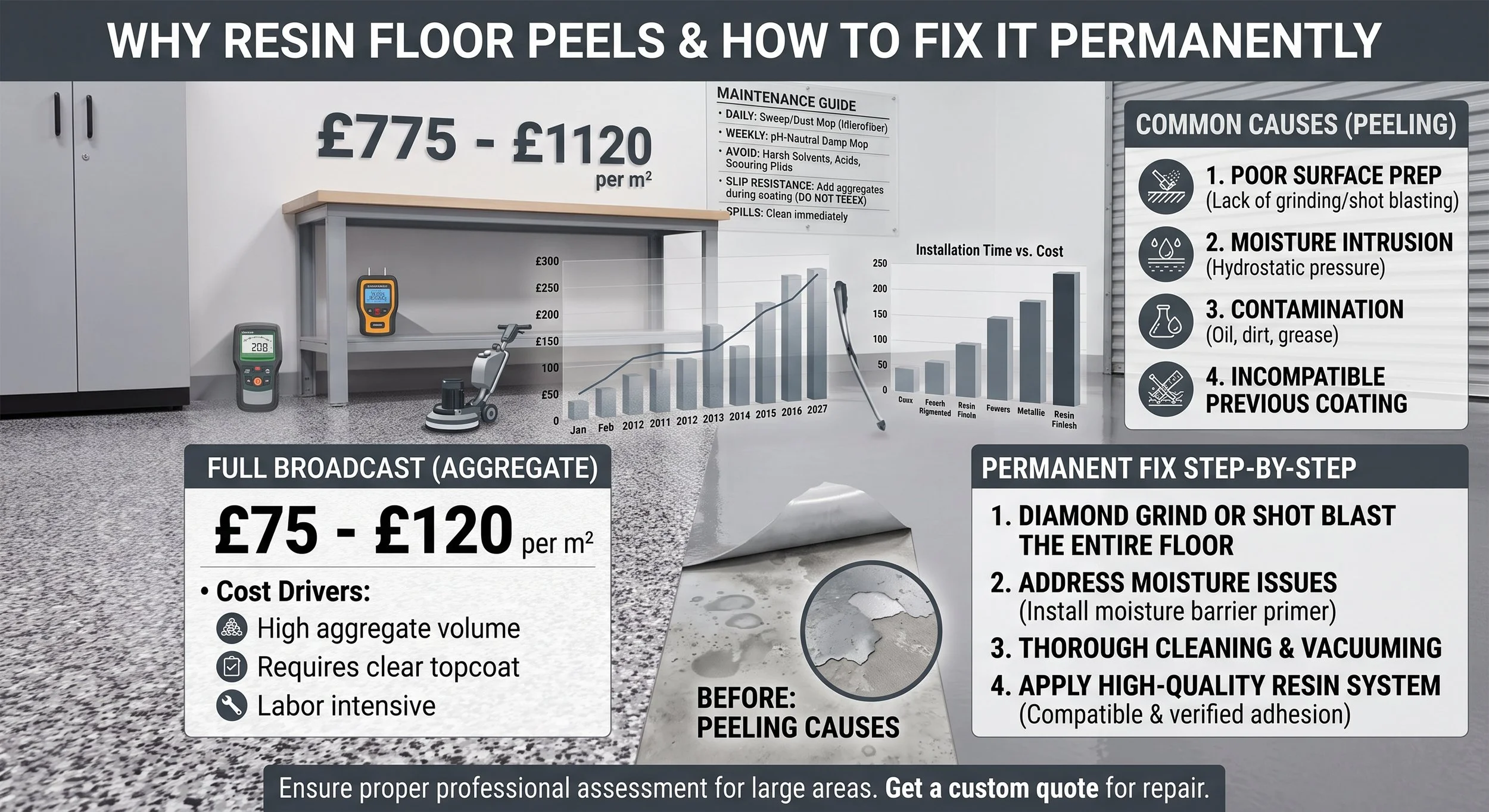
The Top 3 Reasons Resin and Epoxy Floors Fail
When resin separates from concrete, it is called delamination. This happens when the bond between the coating and the underlying slab is broken.
1. Lack of Mechanical Surface Preparation
Concrete is naturally covered in a weak, dusty top layer called laitance, along with residual oils, cures, or old paint.
The Error: Simply jet-washing, acid-etching, or sweeping concrete does not create an adequate key for structural resins.
The Result: The resin sticks to the weak surface laitance rather than the solid slab beneath. As the resin cures and contracts, or under vehicle traffic, it shears off the weak layer and lifts completely.
2. Rising Damp and Hydrostatic Moisture Pressure
Concrete acts like a sponge, drawing water vapor up from the ground.
The Error: Coating a concrete slab that has a relative humidity (RH) above 75% without applying a dedicated damp-proof membrane (DPM).
The Result: Moisture pressure builds up directly beneath the non-porous resin sheet. This hydrostatic force creates fluid-filled blisters that eventually burst and peel.
3. Using Soft or Incompatible Primers
The Error: Applying water-based acrylic primers, standard PVA, or flexible tiling primers beneath rigid 2-part resins.
The Result: Water-based primers remain flexible, soft, and moisture-sensitive. When sandwiched under heavy High Build Epoxy or self-levelling screeds, the rigid top layer pulls against the soft primer, causing the entire floor to shear away.
How Contractors Repair a Failing Resin Floor
You cannot simply paint over a peeling resin floor—any new coating will fail alongside the layer underneath. The entire system must be mechanically removed back to a sound base.
┌─────────────────────────────────────────────────────────────────────────┐
│                   Remedial Resin Floor Repair Flow                      │
├─────────────────────────────────────────────────────────────────────────┤
│ 1. Mechanically Strip Failed Coating (PCD Diamond Scraping)             │
│                                   │                                     │
│                                   ▼                                     │
│ 2. Diamond Grind Slab Profile & Vacuum Dust (CSP 2–3 Profile)           │
│                                   │                                     │
│                                   ▼                                     │
│ 3. Deep Mortar Repairs for Spalls (EpoxySET 105 / Structural Resin)     │
│                                   │                                     │
│                                   ▼                                     │
│ 4. Apply 2-Part Epoxy DPM & Blind with Quartz Sand                      │
│                                   │                                     │
│                                   ▼                                     │
│ 5. Pour Self-Levelling Screed or Apply High Build Epoxy Topcoat          │
└─────────────────────────────────────────────────────────────────────────┘
Step 1: Mechanical Stripping with PCD Scrapers
We use heavy-duty planetary diamond grinders fitted with Polycrystalline Diamond (PCD) scraping segments. PCD scrapers physically slice through failing epoxies, rubberized paints, and old tile adhesives without smearing them across the slab.
Step 2: Concrete Surface Preparation
Once the old coating is removed, we switch to 30-grit diamond grinding shoes to abrade the bare concrete, removing all surface laitance and opening the pores. The floor is then thoroughly vacuumed using M-Class industrial dust extraction.
Step 3: Structural Subfloor Repairs
Fine hairline cracks are filled with low-viscosity repair resins. For deep spalls or damaged joints (>5mm deep), we use high-strength repair mortars like EpoxySET 105 to restore structural integrity flush with the slab.
Step 4: Epoxy DPM Priming & Quartz Scatter
To lock out moisture permanently, we roll out a 100% solids, 2-part Epoxy DPM primer. While the primer is still wet, dry quartz sand (0.3mm–0.8mm) is broadcast across the surface. Once cured, excess sand is swept away, leaving a sandpaper-like surface profile that guarantees a mechanical lock for topcoats.
Step 5: Re-Coating
With the slab sound, dry, and keyed, we apply the final specification—whether a smooth self-levelling screed, High Build Epoxy, or decorative PVA Flake finish.
Fix Your Peeling Floor Once and For All
A peeling floor is a structural failure, but with correct diamond grinding, deep repair mortars, and 2-part epoxy priming, it can be permanently rectified.
Dealing with a flaking or delaminated floor in your garage, workshop, or commercial facility? Contact North West Resin Flooring Specialists Ltd to book a technical floor survey and request a fixed-price remedial quote.