Classic white & grey
Soft mineral greys over a warm white base — the closest look to natural Calacatta or Carrara marble.
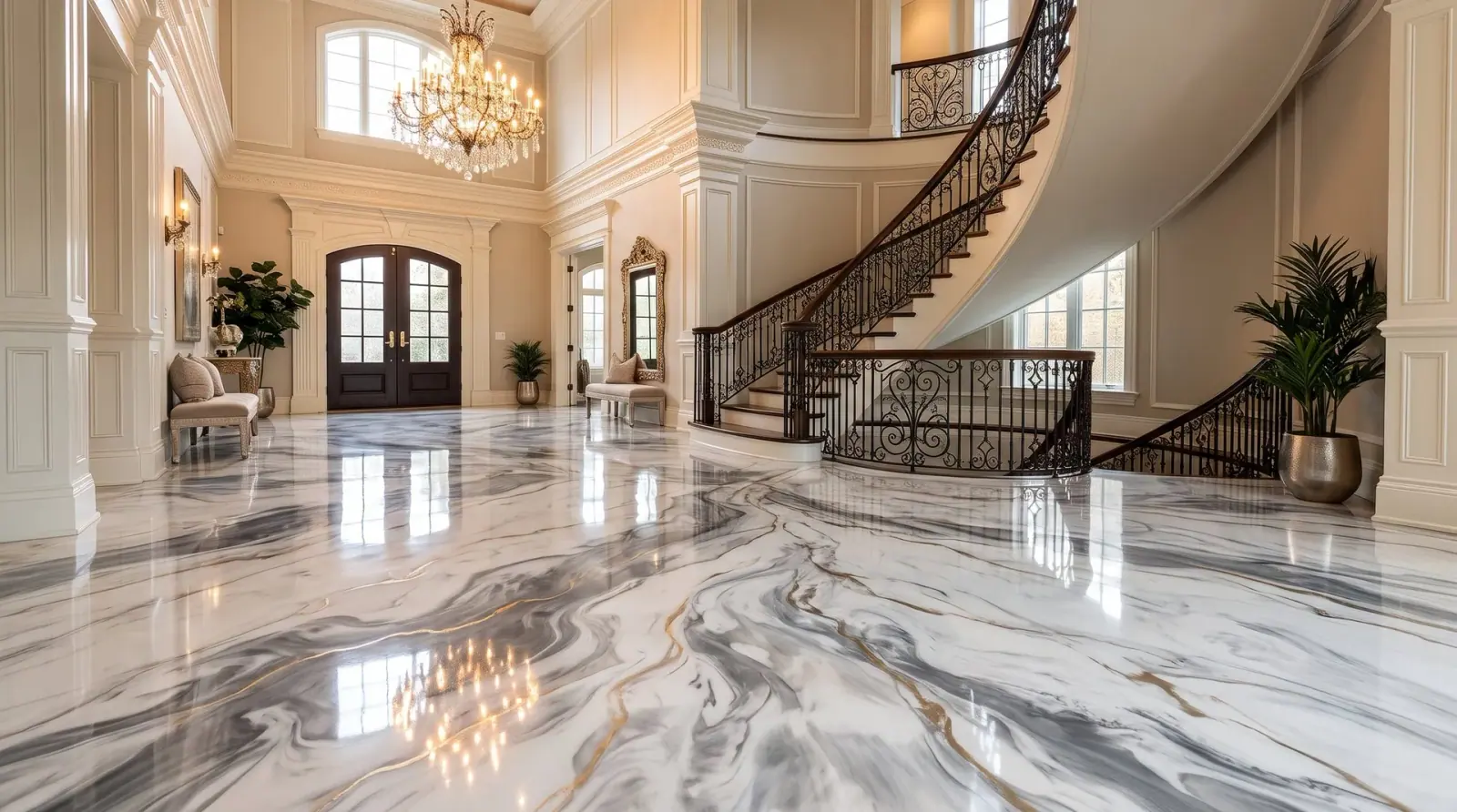
Our signature artisan finish
A liquid marble floor is our signature finish: a seamless marble effect, hand-poured at just 2–3mm thick, with unique mineral veining created on site. It gives you the look of flowing natural marble — with no grout lines, no heavy slab and no two floors ever alike — for living areas, entryways, feature floors and kitchen islands.
★ Trust A Trader vetted🛡️ £5M / £10M insured🧾 Fixed itemised quotes, guaranteed 30 days
Every pour is individual. Here’s a selection of recent work.
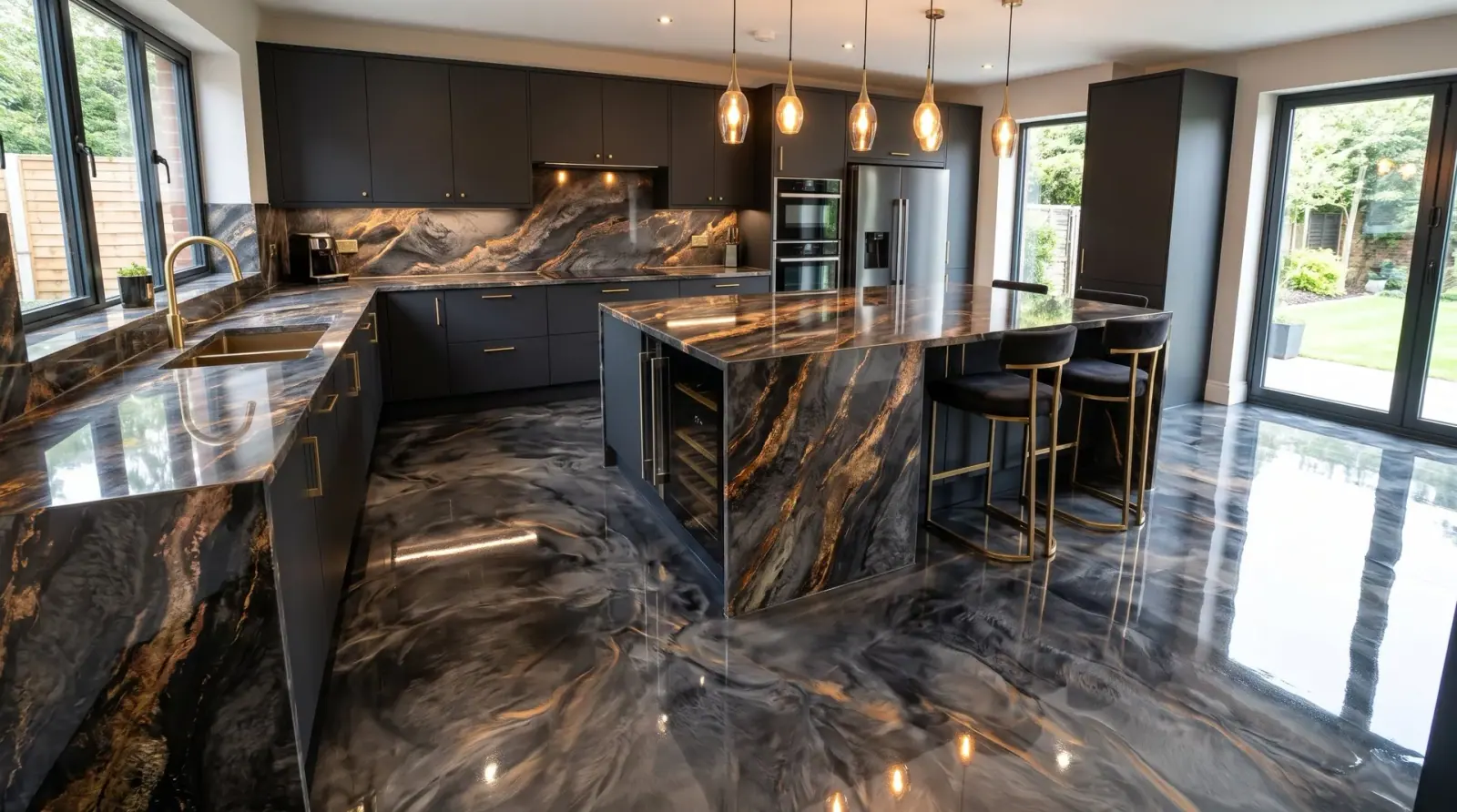
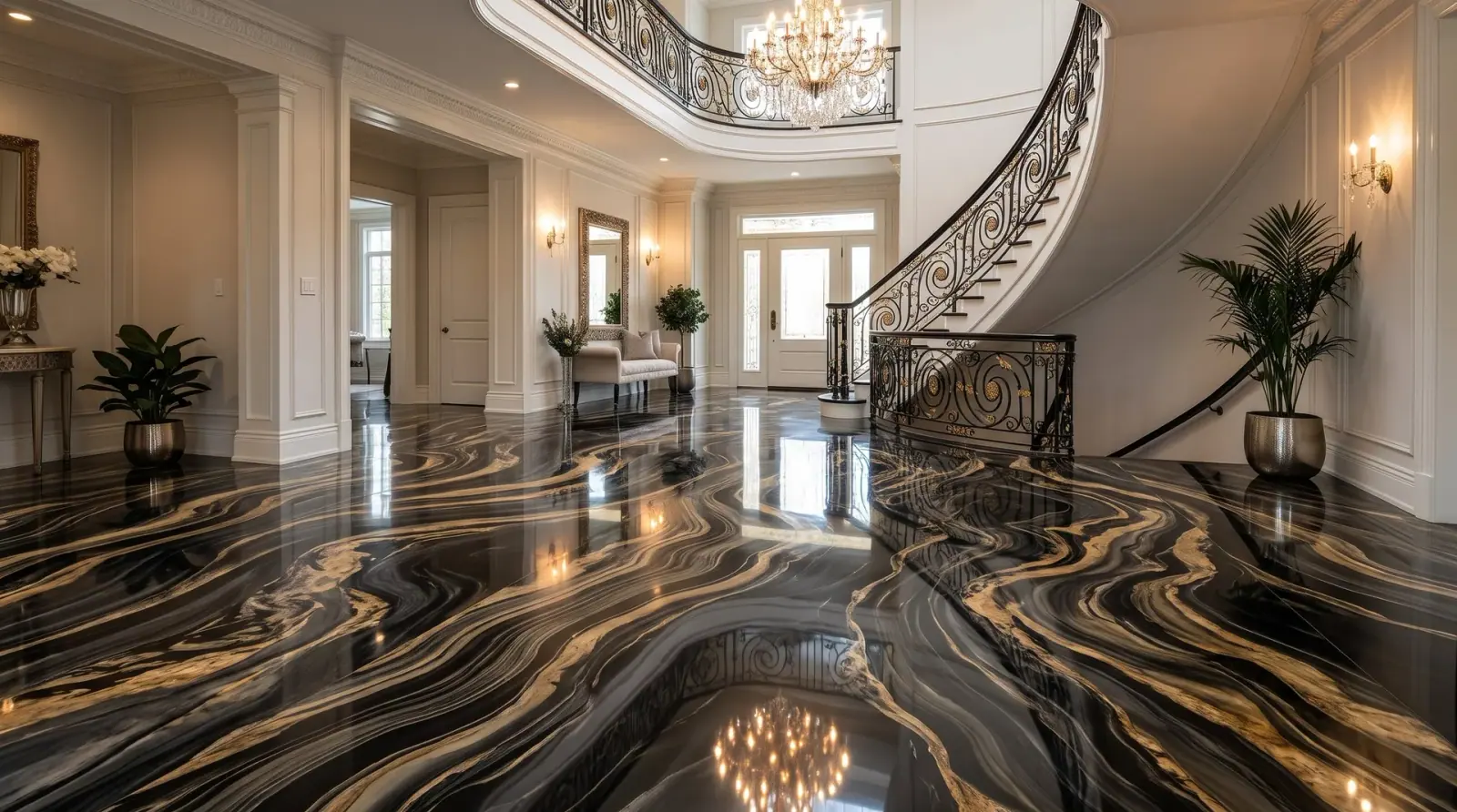
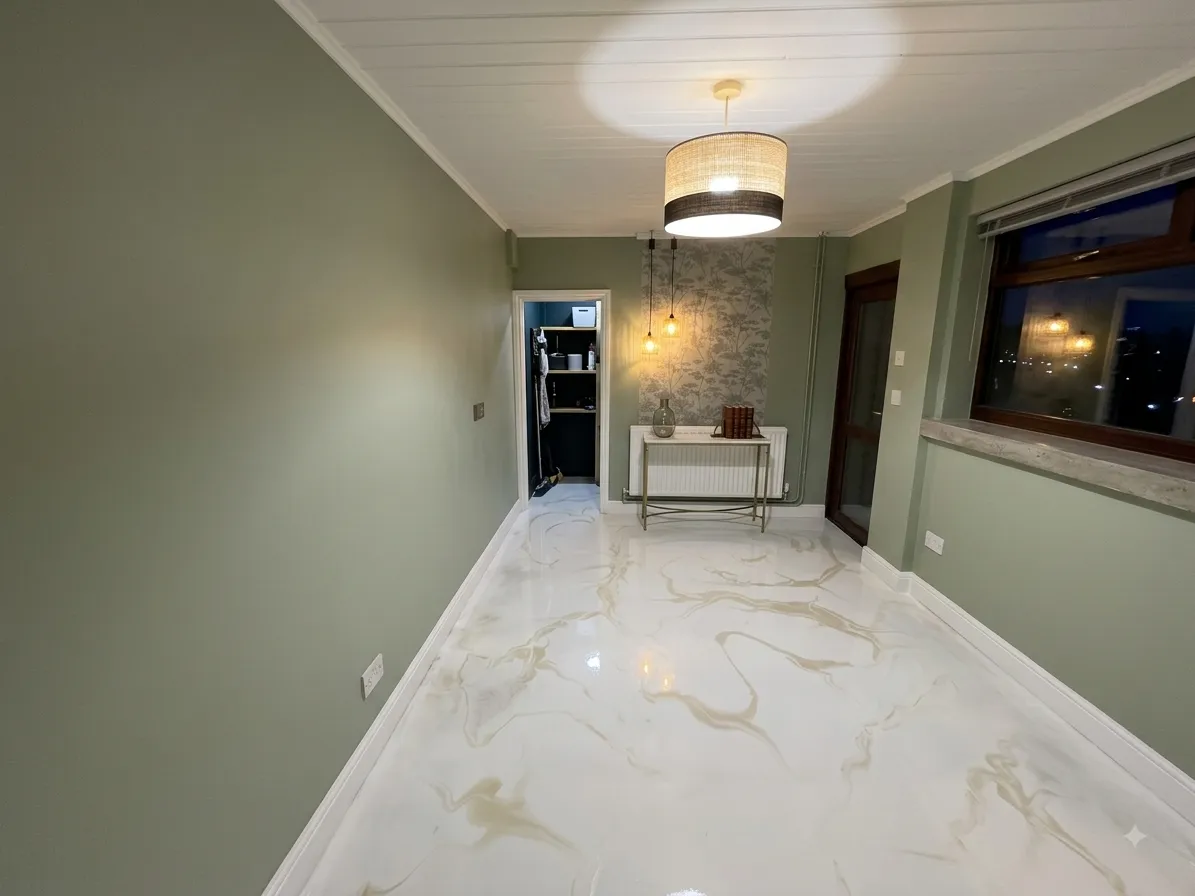
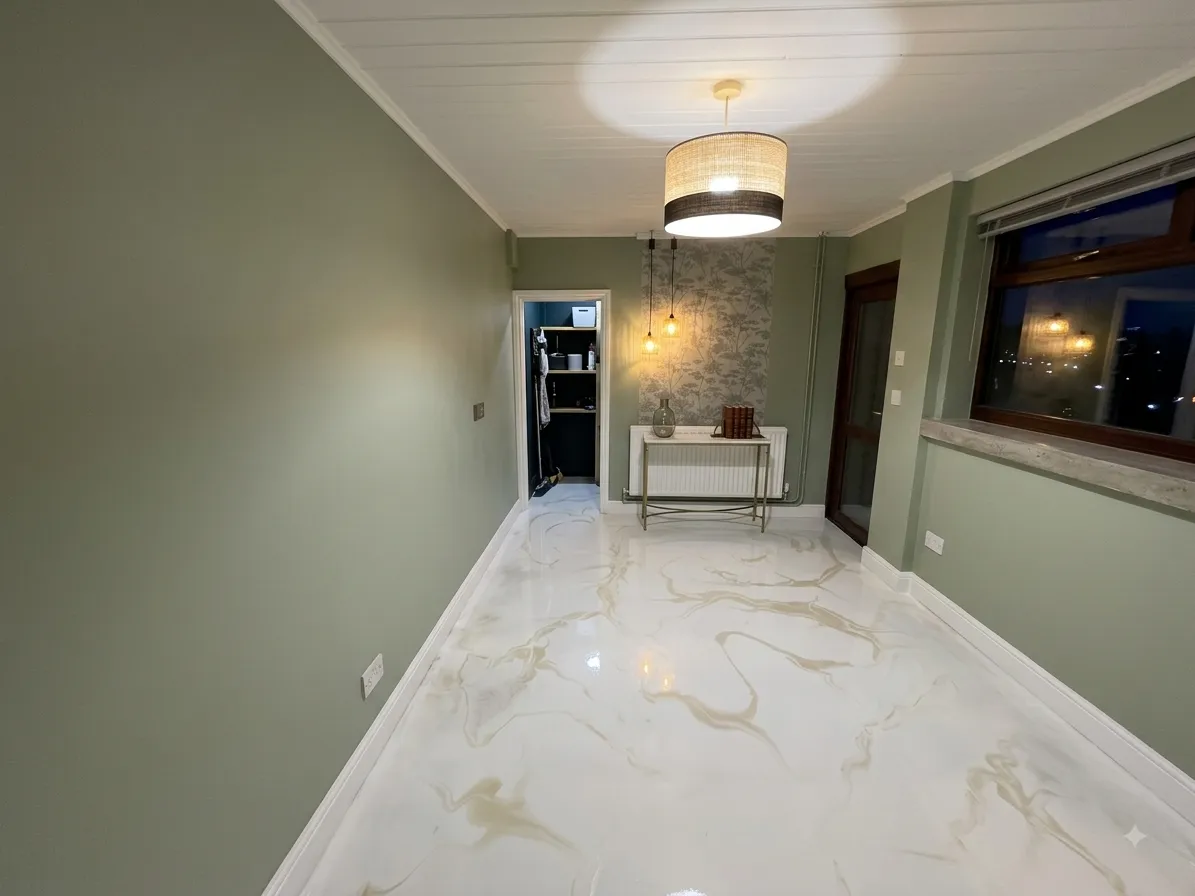
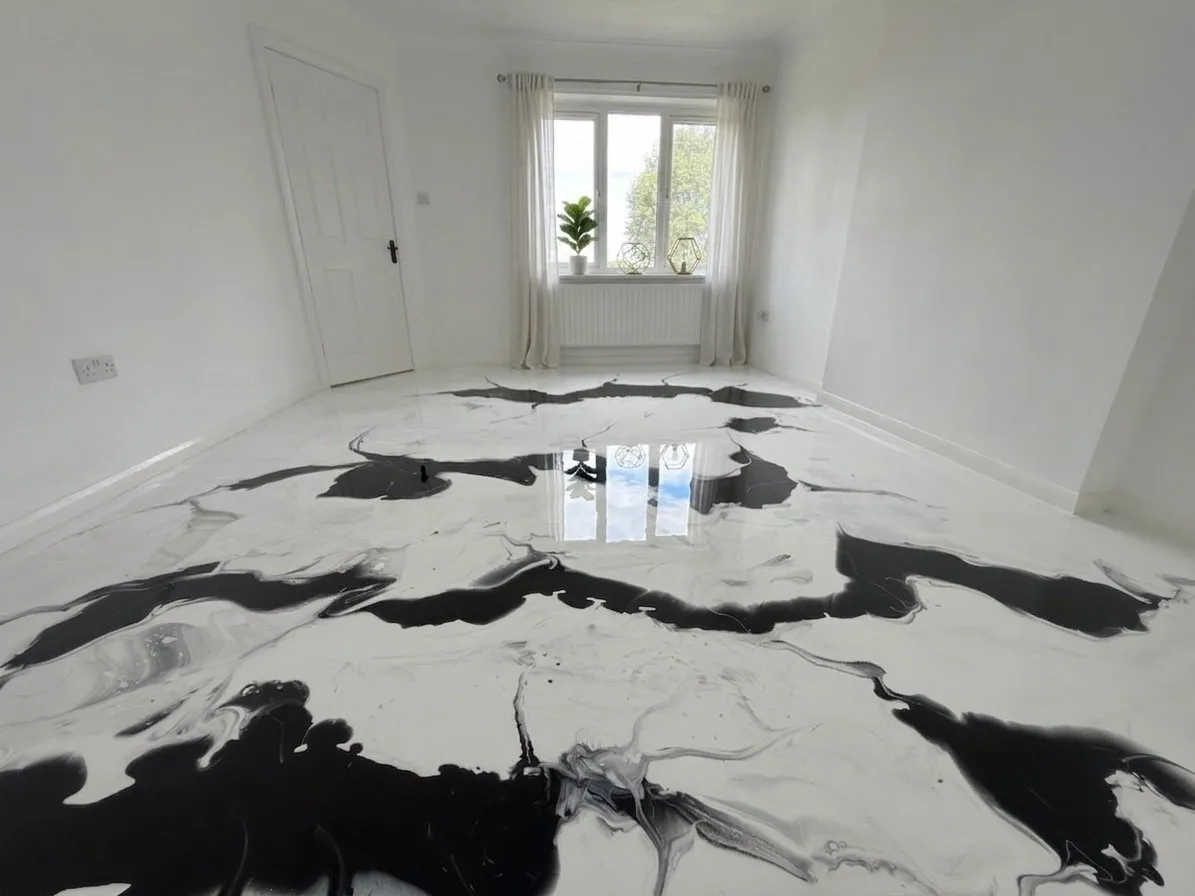
Soft mineral greys over a warm white base — the closest look to natural Calacatta or Carrara marble.
Deep charcoal or black bases with striking gold or copper veining for dramatic hallways and feature floors.
Sands, creams and bronze veining that suit Scandi and minimalist interiors.
Every floor is mixed and hand-poured on site, so we can match your palette, samples or an existing scheme.
We bring physical sample boards to your free survey so you can see and feel the finish before committing.
A seamless marble-look floor across open-plan living spaces, without the cold joints, weight or cost of slab marble.
Make the first impression count with a flowing, one-of-a-kind vein pattern that runs unbroken through the home.
The same technique is poured over islands and worktops, tying the whole space into a single continuous design.
Retail spaces, showrooms and boutique commercial premises where the floor itself is part of the design statement.
Planning the rest of the project? Read our UK resin flooring cost guide, our microcement bathrooms guide, or browse all our flooring services.
There is no printed pattern and no roll of vinyl. The whole floor is made on site, by hand, over two to three days. This is the sequence we follow.
We check the substrate, measure moisture, confirm floor levels and agree the design, sheen and laying pattern in writing before anything is ordered.
Diamond grinding with HEPA extraction removes old coatings, adhesive and laitance, then cracks and hollow spots are cut out and repaired.
A primer seals the surface and an epoxy damp proof membrane is laid where readings require it, so the finish cannot blister from below.
A fibre-reinforced compound takes out undulations and gives the thin marble layer a flat, sound base. It needs its own cure time before the pour.
A pigmented resin base goes down first. This is the ground colour the veins will sit in, so it is mixed to your sample board rather than guessed.
The marble layer is poured and worked by hand while still liquid. Veins are drawn, stretched and softened with tools and heat, one area at a time.
Once cured the surface is flattened and sealed with a protective topcoat in matte, satin or gloss. The space stays off limits while that cures.
Because the working time is short, a pour is planned like a shoot day: one continuous run per room, with enough hands on site to keep a wet edge. Large open-plan floors are poured in planned sections that are blended at the join and then cut back so the seam disappears.
Veining is the part clients ask about most, because it is what separates a convincing marble from a painted floor. It is controlled in four ways.
We pour a small board in your chosen palette before the floor. You approve the actual colour and vein character, not a photograph of someone else's floor.
Metallic and mineral pigments are mixed by hand in measured batches. Concentration, not a file, decides how bold a vein reads.
Veins are drawn to run with the room: along the long axis of a hallway, radiating from a kitchen island, softened at thresholds so the pattern does not stop abruptly.
Warm air opens the resin and lets a vein bleed; solvent slows it and sharpens an edge. That control is what makes a vein look mineral rather than drawn.
No two pours are alike, which is the appeal and also the honest caveat: a vein pattern cannot be repeated exactly for a later extension. If you may extend the space, tell us at survey so the design is planned to continue into it.
These are the timings we work to on a typical domestic pour at normal room temperature. Cold weather, thick builds and heavy topcoats all add time.
| Stage | Typical time | What it means for you |
|---|---|---|
| Underfoot | 24 to 48 hours | You can walk on it in soft shoes. Keep it clean and dry, no dragging loads. |
| Light furniture | 48 to 72 hours | Chairs and light items can go back with felt pads on every leg. |
| Full cure | 5 to 7 days | Heavy furniture, appliances and rugs, and normal washing without care. |
| Underfloor heating | After 7 days | Brought up in steps of a few degrees a day, never straight to full heat. |
| Driving on garage floors | 7 days | Applies to the same system laid in a garage or workshop rather than a living space. |
Plan the room to be out of use for roughly a week, and keep the heating steady and the windows closed against dust during the first 24 hours. We give you the exact schedule for your floor in writing before we start.
A worktop poured in the same system is a tougher question than a floor. It looks superb and it is sealed against water and stains, but no resin surface enjoys a hot pan or a knife edge, so we only recommend it where the client is happy to treat it like a fine timber worktop. If you want a surface that shrugs off abuse, stone or a stainless top is the honest answer.
Yes, and this is one of the real advantages over slab marble. A chip or scratch is repaired in situ, without lifting the floor.
Polished back and re-sealed. Usually a same-day visit with no visible trace.
The damaged area is cut back, re-primed and re-poured to match the surrounding colour, then blended and sealed. Done well it disappears; on a bold vein it can be visible if you look for it.
After many years the whole topcoat can be refreshed without replacing the marble layer beneath it.
A repair is only as good as the person doing it, because the veins have to be recreated by hand. We keep a record of the pigments used on your pour so a later repair can be mixed to match, and we come back rather than leaving it to a general builder.
An honest comparison of the four finishes clients usually weigh up for a living area, hallway or kitchen. Prices are typical UK installed ranges and vary with specification and site.
| Finish | Cost installed | Weight | Seams | Maintenance | Repair |
|---|---|---|---|---|---|
| Liquid marble (ours) | £85 to £120 per m² + VAT | 2 to 3 mm thick, no structural load | None. One continuous surface | Damp mop, pH-neutral cleaner. Re-seal topcoat after years of use | In situ patch repair and re-seal |
| Real marble slab | £150 to £400 per m² + VAT | 20 mm slab, roughly 50 kg per m² | Joints between every slab, plus a movement joint | Seal regularly. Marble is porous and etches with acid | Specialist stone repair, or replace the slab |
| Porcelain tile | £50 to £110 per m² + VAT | 10 mm tile plus adhesive, adds floor height | Grout line every tile, which darkens and needs cleaning | Grout scrubbing and periodic re-grouting | Replace individual tiles, grout rarely matches |
| Printed vinyl | £30 to £65 per m² + VAT | 2 to 3 mm, light and quick to lay | Welded or lapped seams in a large room | Easy to clean but edges lift and wear | Patch repair, visible as a patch |
The short version: real marble wins on authenticity and loses on price, weight and staining. Porcelain wins on toughness and loses on grout lines and level changes. Printed vinyl wins on cost and loses on depth, seams and longevity. A liquid marble floor sits between them on price and is the only one of the four that is genuinely seamless at this thickness.
A liquid marble floor is an artisan resin finish, hand-poured at 2–3mm thick, that recreates the look of natural marble — complete with unique mineral veining. Because every floor is mixed and worked by hand on site, no two patterns are ever the same.
Bespoke metallic and marble-effect finishes typically run £85–£120 per m², + VAT, depending on the design and preparation required. Every project is priced in a fixed itemised quote, guaranteed for 30 days with no hidden fees.
It’s poured in place, so there are no grout lines, joints or heavy structural load. At 2–3mm it goes over existing floors without raising levels, and it works with underfloor heating. It also costs significantly less than supplying and fitting natural stone.
Yes. It’s a sealed, non-porous resin surface designed for everyday home life, and it can be installed in matte, satin or high-gloss sheens. Like any fine finish, it performs best over a correctly prepared subfloor — which is included in every install.
Yes — our liquid marble overlays are fully compatible with wet and electric underfloor heating.
Across Greater Manchester, Cheshire, Merseyside, Lancashire and North Wales — including Wilmslow, Altrincham, Liverpool, Chester and surrounding areas.
More questions? Read our full FAQs.
See sample boards in your own space and receive a fixed itemised quote, guaranteed for 30 days.
We use analytics cookies to understand how visitors use our site. They are only set if you accept. You can read more in our privacy policy.